


Introduction
I am in the midst of writing a paper focused on tools for building community resilience. As the article writing process is long, and time is scarce, I wanted to release these tools into the world now, and the formal literature will follow. Please consider the following to be the exclusive property of Gregory Vigneaux in the interest of publishing, but I hope you will enjoy it nevertheless. If you would like to use a tool or concept found below, please get in touch with me at greg@operationalcoherence.com.
It is important to keep in mind that this material is not presented as a fix to a problem, but rather a paper-based tool to be leveraged to build wildfire community resilience. In doing so, the intent is that it will open a pathway for technological strategies to visualize wildfire community risk and then integrate social and organizational strategies to reduce it physically.
This post introduces two visual tools for designing, giving form to, and implementing community resilience-building strategies. The use of visual tools is intended to make resilience-building strategies clearer, more accessible, and readily understandable with reduced training times in comparison to heavier, text-based delivery methods. The tools, tentatively named EidosCube and SenseCraft, both include their own informed language intended to remain consistent across uses so that they may become familiar, further reducing the mental load required by designing and then implementing a strategy.
Strategy
Axelrod and Cohen (2000) define strategy as the way an individual or group “responds to its surroundings and pursues its goals” (p. 4). and is essential across all phases of the disaster risk management cycle. A resilience-building strategy is a specific strategy that outlines how an organization will ultimately pursue its goal of working with a community to co-create resilience within it. Strategy is an act of design. Meaning, making decisions about what should exist in the future and then acting in a way that materializes them. Design exists from the inception of the strategy itself, through how others are intended to interact with it, and how it should affect the community.
EidosCube Version I
The visual tool immediately below was introduced during the author’s talk, “Are you Transitioning or Refining the Present: A Theoretical Look at Wildfire Adapted Community Change.” It has since been referred to as “EidosCube,” meaning “FormCube.” EidosCube gives form to thought before giving form to action. The cube’s use is first formulating a strategy visually and then providing a visual tool for understanding and implementing it. The tool is about strategy, both in design and in how it should be implemented. There is a point where the tool use transitions from being a tool to define strategy to a tool to implement strategy.

EidosCube I
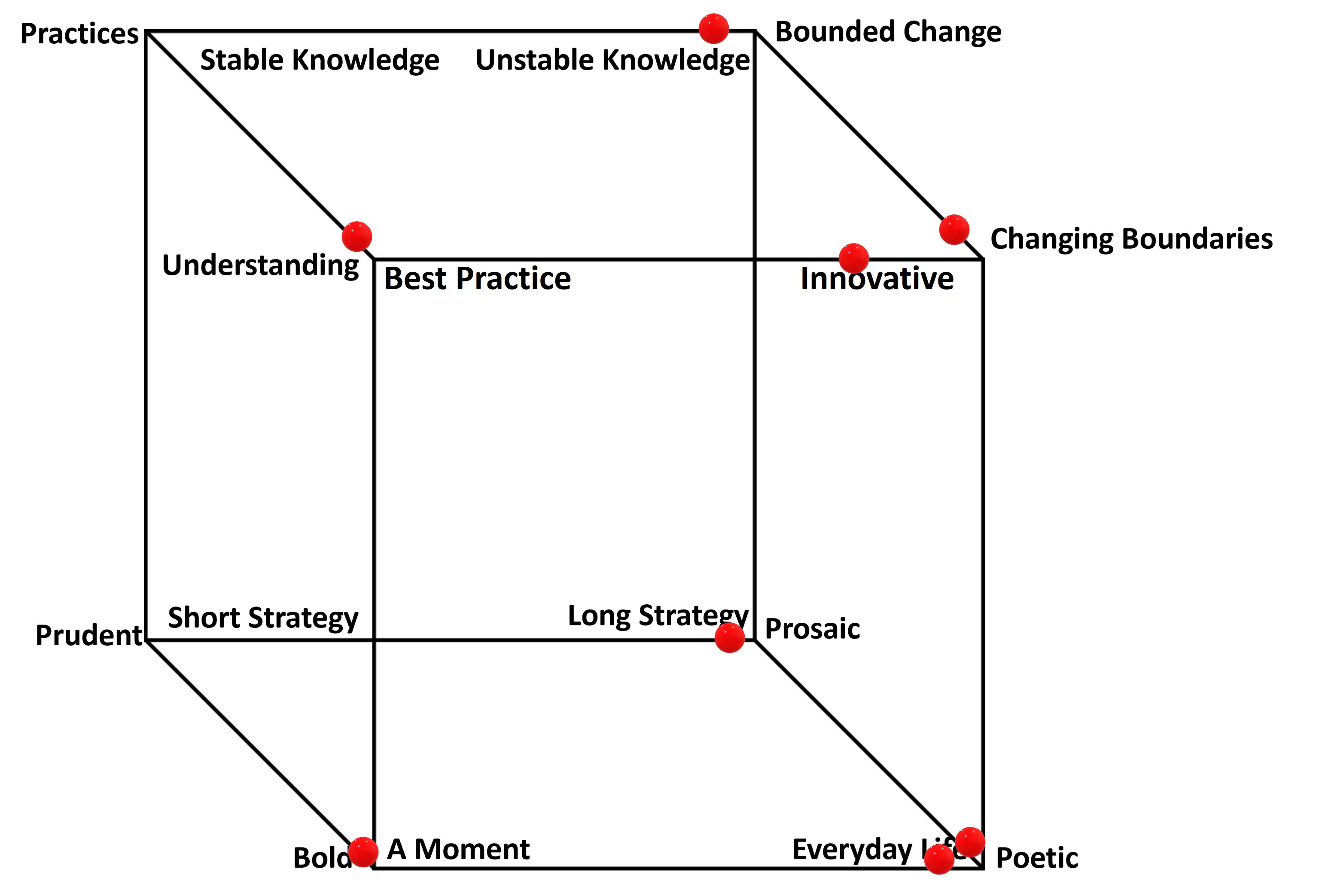
Both versions of the cube tool have the same functionality, though they have different forms and labels. The first version immediately below is visually simpler than EidosCube II, and used earlier language to describe the dimensions that were less clear, and were further developed later in version II.
The first version of the EidosCube maps an aggressive community resilience-building strategy, where each dot represents the end of each dimension. Designed only for demonstration purposes, such a strategy would likely never be deployed, as it addresses too many community variables at once, and has a high risk profile of disruption and harm while turning the scientific waters turbid and leaving implementers at a loss as to which specific dimension of the strategy produced which negative or positive change. Operating in the extremes of these dimensions, especially all at once, or for the majority, is far from prudent.
Version I does, however, represent a use case as to how the tool could be engaged with as designers and implementers. Designers map the strategy on the cube, setting where it falls along each dimension, organizing and materializing their thoughts until it is picked up by someone implementing the strategy, and then it becomes a visual tool to organize and guide their thoughts around implementing the strategy.
EidosCube Version II
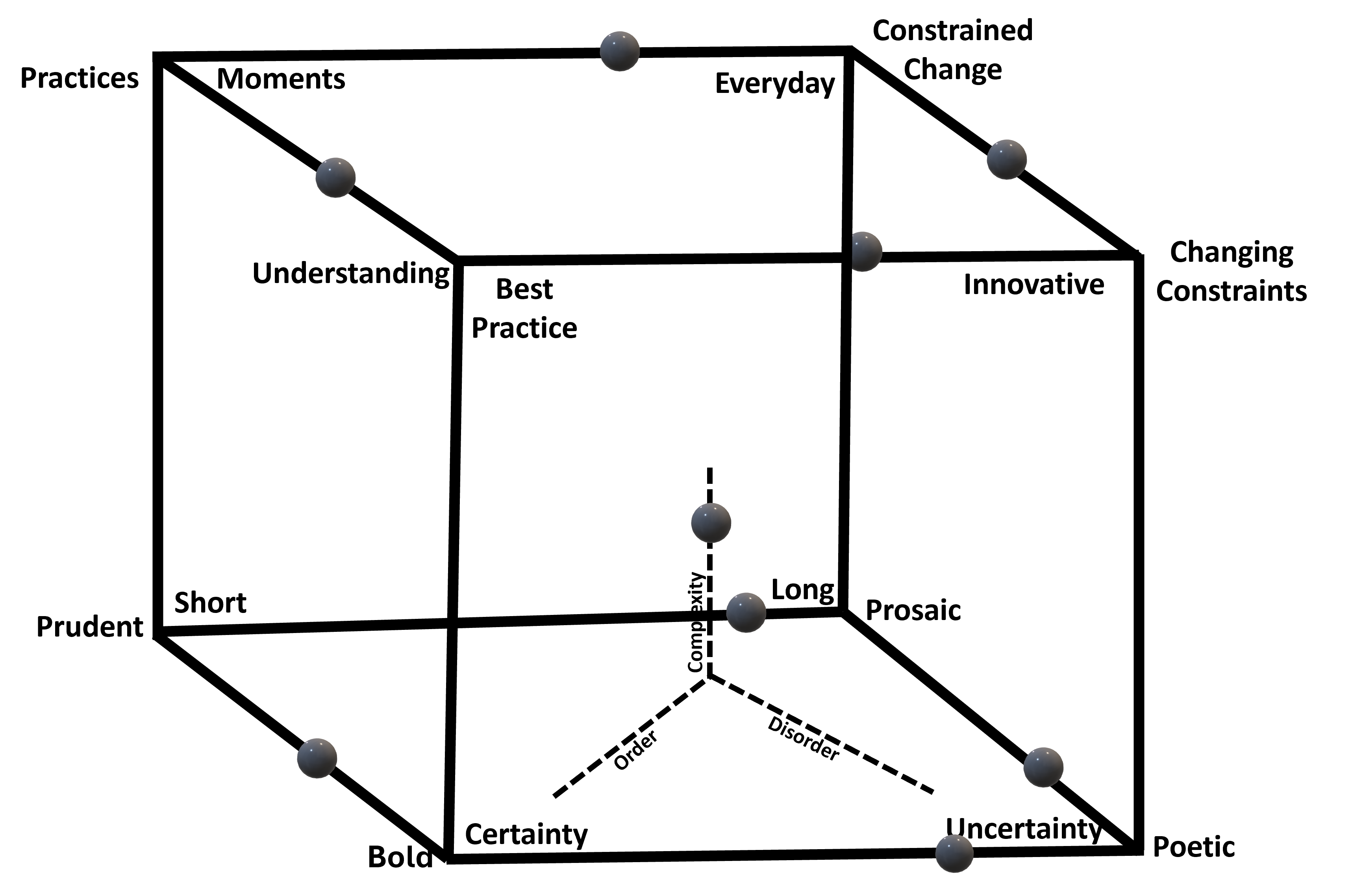
The tool below in Figure 3 is Eidos Cube version II, or simply “EidosCube.” The value of the cube’s dimensions and the three-axis tool in the middle of Figure 3 are all explained in the list below. The three-axis tool within the cube does admittedly complicate the visual field in its expression of how complex, ordered, or disordered the strategy implementation environment is going to be or will even become. Over time, this version of the EidosCube may evolve. It is the second iteration, which formerly used three Y-axes to map order, disorder, and complexity. With the inclusion of the tool in the middle of the visualization, the EidosCube is more complete and offers a more comprehensive understanding of strategy implementation.
The EidosCube, shown below, has been populated to be a moderate strategy with knowledge certainty, duration, and the dimension of style taking the most extreme positions, while the remainder are relatively balanced. As the EidosCube and its dimensions are unpacked in the list below, the EidosCube gives form to the design of the strategy and what it is intended to accomplish, and how, and the predominant nature of the environment in which this work will take place, which is represented as complex.
The EidosCube Version II
Bottom of the Cube
Risk Attitude
Will the strategy be prudent, concerned, and risk-averse, or bold, confident, courageous, and risk-taking?
Strategy Duration
Will the strategy be implemented over a short or long duration?
Knowledge Certainty
Will the strategy expect steady, unchanging, certain knowledge of the community, or knowledge that lacks a stable state and evolves unpredictably?
Style
Will the strategy be prosaic, meaning “life made of practical, utilitarian, and technical chores” (Morin & Kern, 1999, p. 138) or more poetic, which is to say “a way of life involving participation, love, eagerness, communion, enthusiasm, [and] ritual” (Morin & Kern, 1999, p. 138)?
Top of the Cube
Change Focus
Will the strategy seek change at the level of practices or understanding (Shove, Pantzar, & Watson, 2012; Spinosa, Flores, & Dreyfus, 1999)?
Experience
Will the strategy seek to change a moment or moments in the flow of someone’s living or alter the course of their everyday life?
Constraints
Will the strategy seek to create change within pre-existing constraints or change the constraints themselves (Juarrero, 2023; Morin, 1992)?
Approach
Will the strategy use established and accepted practices or utilize original methods (Snowden & Boone, 2007)?
Inside the Cube
Order
Will the strategy implementation process encounter an environment of invariance, constancy, repetition, a high degree of probability, operating as if placed under the control of law (Morin, 2008)?
Complexity
Will the strategy implementation process occur in a setting that is a fluctuating mixture of order and disorder, where the elements are tangled and impossible to grasp, describe, and explain completely, and where predictions are verified only after the fact (Axelrod & Cohen, 2000; Morin, 2008)?
Disorder
Will the strategy implementation take place in a disorderly context characterized by instability, randomness, irregularity, and divergence from established frameworks, with the possibility of developing into chaos, where there is no stability, and it exists “beyond our logical intelligibility” (Morin, 1992, p. 57; Morin, 2008; Waldrop, 1992)?
List 1. 2026 Gregory Vigneaux. All rights reserved.
The EidosCube was heavily inspired as a tool for wildfire community risk reduction by a reading of Morin and Kern (1999), even if their work is not cited in each dimension. As seen above, each axis is referred to by a particular label and carries a certain meaning related to building resilience, with a focus on what the strategy hopes to accomplish and the environment it will do so in. The intended use for this list, elsewhere provided in table format, is to accustom both user groups to the tool, so that they become less dependent on the descriptions and labels over time and are eventually able to use the tool without hesitation. It will then be imperative that the language remains stable over time, so it can be learned and executed.
SenseCraft
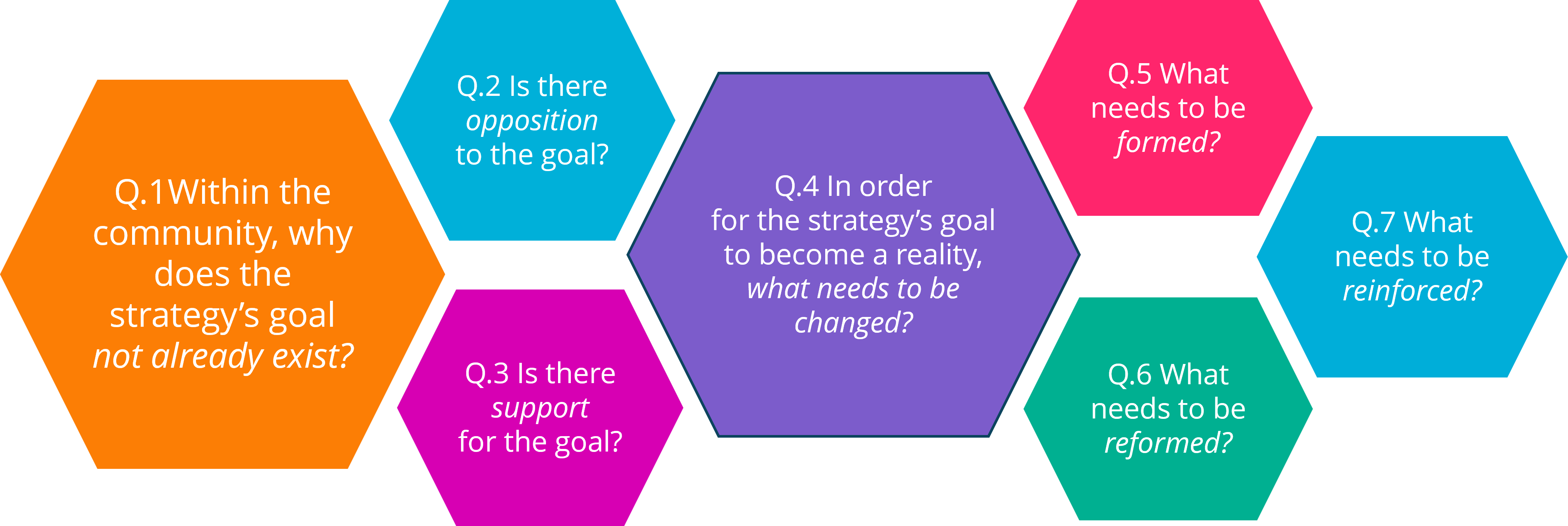
While originally presented in a different form and distinct language, the essence of the questions below was presented in a paper I co-authored titled “Research-into-Action Brief: Developing and Implementing Comprehensive School Safety Policy.” Years after it was published, the format in which the questions were presented was changed to the visual tool seen in Figure 4, with the language modified slightly. It now exists as a tool for strategy implementation.
The evidence-based questions in SenseCraft could only be produced after a study of complex adaptive systems and design studies. The knowledge gained from this study became the foundation for the questions and became embedded in them, and is intended to be passed on to the end user whose behavior it will shape. While there is extensive study underlying these questions, the user does not need to concern themselves with it, as the resultant knowledge has been delegated to the tool and may be enacted through use. SenseCraft is another example of how visualization can reduce training times through delegating knowledge to the tool and not the person, in its two main questions, with corresponding sub-questions.
There is a designed flow of the questions that guides the user through sense-making concerned with why the strategy’s goal is not already present in the community, asking further if it is due to opposition, and also seeking support for the goal, before the tools asks what would need to be changed for the strategy’s goal to become a reality, with three follow up questions asking what needs to be formed, reinforced, and reformed. SenseCraft’s seven questions are significant and may lead to new, additional main and sub-questions in the course of strategy implementation, which would be an effective use of the tool. As it is presented here, SenseCraft is a vital, core beginning to the implementation process.
Conclusion
This post has endeavored to communicate the value of visual tools in the wildfire community resilience-building space. Visual tools, especially those presented in Figures 2 and 3, have the dual purpose of driving the design process and the implementation process, in the name of coherence. While Figure 2 includes a list to explain its uses, Figure 4 is designed to be ready to engage with immediately. Both tools are theory-driven, though that theory may not be readily obvious and is instead enacted through use. The design of a tool that goes on designing as a tool for defining strategy and then shaping the actions of those who use it must begin with theory to responsibly guide its development.
References
Axelrod, R., & Cohen, M. D. (2000). Harnessing complexity: Organizational implications of a scientific frontier. New York, NY: Basic Books.
Juarrero, A. (2023). Context changes everything: How constraints create change. Cambridge, MA: The MIT Press
Morin, E. (2008). On complexity. (R. Postel, Trans.) Cresskill, NJ: Hampton Press.
Morin, E. (1992). Method: toward a study of humankind: the nature of nature (Vol. 1). (B. J.L Roland, Trans.) New York, NY: Peter Lang.
Morin, E., & Kern, A. B. (1999). Homeland earth: A manifesto for the new millennium. (S. M. Kelly, & R. LaPointe, Trans.) Cresskill, NJ: Hampton Press.
Shove, E., Pantzar, M., & Watson, M. (2012). The dynamics of social practice: Everyday life and how it changes. London: Sage.
Snowden, D. J., & Boone, M. E. (2007). A leader’s framework for decision making. Harvard Business Review, 85(11), 68-76.
Spinosa, C., Flores, F., & Dreyfus, H. L. (1999). Disclosing new worlds: Entrepreneurship, democratic action, and the cultivation of solidarity. Cambridge, MA: MIT Press.
Waldrop, M. M. (1992). The emerging science at the edge of order and chaos. New York, NY: Touchstone.